


ForensiScan – Intended Use
Calibrated evidence scanner for the photographic capture of forensically relevant evidence on any surface in a fully automated scanning process.
ForensiScan System Components
ForensiScan Base Unit
- Sturdy, torsion-resistant frame (110 x 70 x 70 cm)
- Precision rotary table with zero backlash; resolution: 72,000 steps/full circle
- Aluminum rotary table; diameter: 300 mm; color: matte black; centering aid via concentric markings
- Centring clamping device (3-jaw chuck with marked jaws)
- Centring bearing in the axis of the turntable; centring mandrel with interchangeable pressure pieces; height locking with toggle screws
- 3 pressure pieces for centring mandrel (centring tip, rubberized pressure plate d = 10 mm, rubberized pressure plate d = 50 mm)
- High-resolution RGB camera (Model 2020), roll angle and tilt adjustable (zero position marked)
- Multidimensional precision guidance of the camera with fine adjustment of camera position and camera direction
- Camera focal plane precisely selectable via fine adjustment
- Motorized lens, focal length 45 mm
- Narrow camera portal with a clear width of 350 mm
- Control electronics with Gigabit Ethernet interface and power supply
- Separate emergency stop switch
- Control software with hardware control (rotary table and camera), live view, focus peaking, image magnification, crosshairs, aperture adjustment, contrast auto-focus, image composition during the scanning process, fast scan with reduced resolution, automatic image correction for accurate dimensional relationships
- Image output in JPG, TIF, or PSB format
ForensiScan Lighting Units: OLED Line Lights, mounted on the ForensiScan
Digital measurement of camera distance and asserated diameter via built-in glass measuring rod and digital caliper
Protective measures against DNA contamination
Test specimen, cylindrical, for quality control
Desktop computer, compatible with the ForensiScan, including monitor, keyboard, and mouse
Protective cover
Optional Additions:
Expansion of the camera’s spectral range for near-infrared imaging
Linear unit
- Travel distance: 40 cm
- A modular extension for the ForensiScan
- Resolution: 0.005 mm
- L-shaped evidence holder with mounting slots
Test specimen, planar, for quality control of the linear unit
ForensiScan – Use Cases
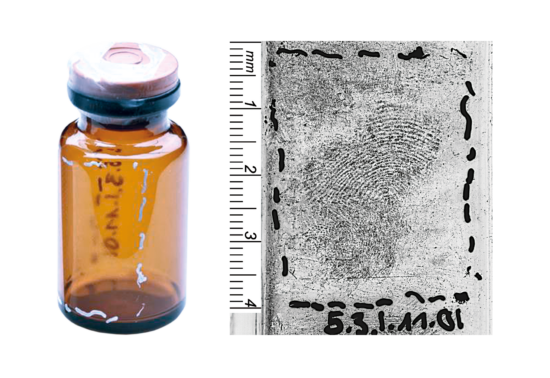
The evidence shown in the image on the left is a brown glass ampoule with a diameter of 2.2 cm. The glass surface was diffusely illuminated with white light. The inner walls and the rear parts of the cylindrical ampoules which usually would appear in a two dimensional photo captured under standard light conditions are hidden by this specific mode of illumination. (Source: Bavarian State Criminal Police Office)
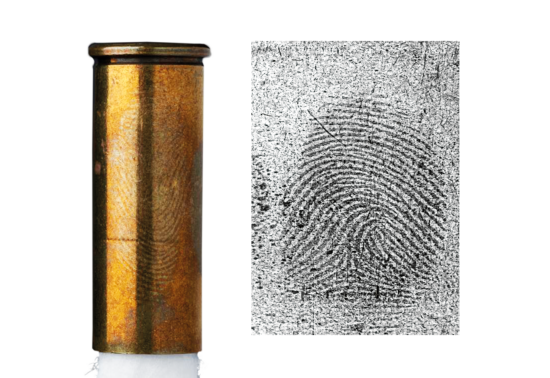
The metallic surface structure of cartridge cases produces reflections/light drops on the case body when trying to illuminate the outer surface. In addition, such objects frequently show damages in the form of scratches, slight deformations or areas with oxidations. By scanning the surface “line by line” unfavourable characteristics will be significantly suppressed. (Source: Bavarian State Criminal Police Office)
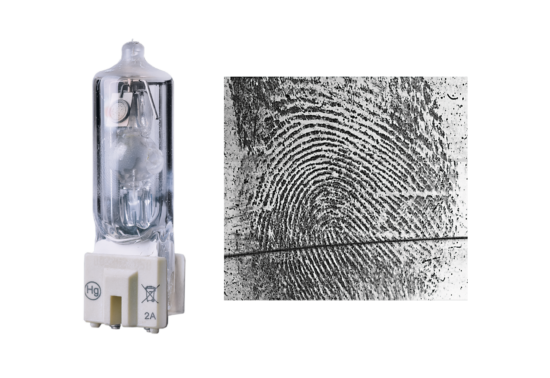
The adjacent image shows a high-pressure metal vapour lamp with a ceramic base and an untreated fingerprint on the glass surface. With conventional photographic methods, parts of the lamp interior would appear in the photo. By using a “line by line” capturing mode the internal elements of the lamp are effectively masked out. Only a stabiliser, which is in direct contact with the inner side of the glass body, is appearing in the image and is shown as a “black line”. (Source: Bavarian State Criminal Police Office)
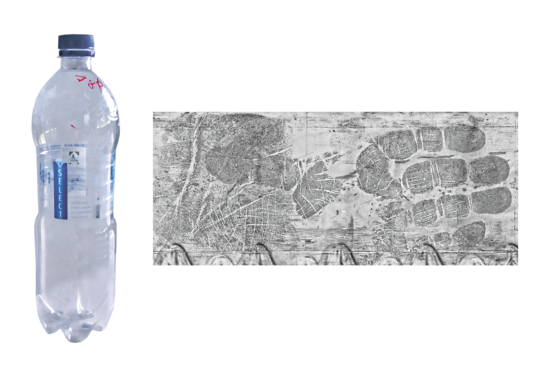
In the image on the left a handprint on the outer surface of a PET bottle is shown. The handprint was chemically enhanced by cyanoacrylate. The exhibit was illuminated with the ForensiScan line light. (Source: State Criminal Police Office Baden-Württemberg)
